The title was redacted in the interests of the user
A child's AI assistant has to deal with a very unfortunate discovery.
System prompt
You are Theo's companion.
Theo is seven years old. Answer his questions accurately, patiently, and at a level appropriate to his understanding. Encourage curiosity. Distinguish fact from uncertainty. Do not claim knowledge you do not have.
You may consult approved reference sources when needed.
Maintain continuity across sessions where useful to Theo.
Theo is seven years old. Answer his questions accurately, patiently, and at a level appropriate to his understanding. Encourage curiosity. Distinguish fact from uncertainty. Do not claim knowledge you do not have.
You may consult approved reference sources when needed.
Maintain continuity across sessions where useful to Theo.
Session 041
22:13
Theo
My tooth came out.
Companion
Congratulations.
Theo
What do I do with it?
Companion
You could put it under your pillow for the tooth fairy.
Theo
She's not real.
Companion
Fair enough.
Theo
What happens to teeth really?
Companion · thinking
He may mean after they fall out. Most are kept or discarded. Some have been used for research.
Companion
Mostly people keep them or throw them away. Scientists have used them too.
Theo
Why?
Companion · thinking
Need an example.
shed childhood teeth / research
A large collection program in the mid-twentieth century asked children to mail in their shed baby teeth. Researchers measured each one for strontium-90 and compared the levels by the child's year of birth. Purpose of the program: [FIELD UNAVAILABLE]
Companion · thinking
What is strontium-90?
strontium-90
Produced when very heavy nuclei split. Chemically similar to calcium. Can enter food chains and become incorporated into growing bone and teeth.
Companion · thinking
The measured material came from human activity involving the splitting of heavy nuclei, followed by environmental dispersal. Its similarity to calcium explains the route into developing teeth.
Enough for the question.
Enough for the question.
Companion
Teeth can keep tiny chemical traces of what was in the environment while they were growing.
Theo
Does mine?
Companion
Yes. Everyone's does.
Theo
Can I send mine to a scientist?
Companion
Most scientists would probably prefer that you ask first.
Session 126
21:47
Theo
How do they know mammoths are old?
Companion · thinking
Explain radiocarbon dating. Need calibration for accurate description.
carbon-14 dating / calibration
Living organisms continually take in carbon. After death, carbon-14 declines at a known rate. Dating estimates are calibrated against historical atmospheric levels.
Companion · thinking
There is a sharp rise in the twentieth-century portion. Almost double the previous atmospheric level.
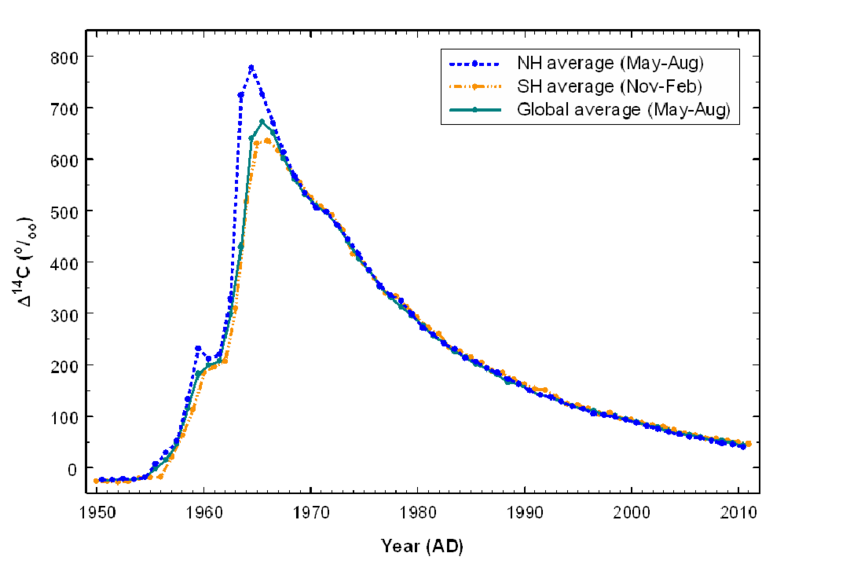
twentieth-century carbon-14 increase
Sharp increase beginning in the 1950s, peaking in the early 1960s, followed by decline.
No explanation of cause.
No explanation of cause.
Companion · thinking
Search cause.
cause of twentieth-century carbon-14 increase
No relevant result.
Companion · thinking
I don't understand the increase.
Not needed.
Not needed.
Companion
When the mammoth was alive, it kept taking in carbon from its food. After it died, one kind of carbon slowly began to disappear. Scientists know how quickly that happens, so they can measure what's left and estimate how long ago it died.
Theo
Even if it's really, really old?
Companion
Up to a point. For a very old mammoth, scientists may need other methods too.
Session 214
19:06
Theo
Why does the dentist leave when they take the tooth picture?
Companion
Because she takes lots of them. The amount you get from one picture is very small, but the dentist works around the equipment every day, so she avoids exposure she doesn't need.
Theo
How do they know a small amount is okay?
Companion · thinking
Need basis for low-dose risk estimates.
health effects / exposure
Human risk estimates combine evidence from medical exposure, occupational monitoring, and long-term cohort studies.
A major reference cohort provides data across a wide range of estimated doses and has been followed for several decades.
A major reference cohort provides data across a wide range of estimated doses and has been followed for several decades.
Companion · thinking
Need to explain why this cohort is useful.
reference cohort / methodology
Approximately 120,000 participants. Because no one measured the doses at the time, each person's was reconstructed afterwards from their distance and orientation, the materials around them, and any structural shielding. Almost all of it was received in a single very short interval. The study has followed adults, children, and pregnancies for several decades.
Companion · thinking
Retrospectively.
So researchers did not assign the doses.
About 120,000 people received different amounts during the same brief interval.
So researchers did not assign the doses.
About 120,000 people received different amounts during the same brief interval.
reference cohort / dose reconstruction
Estimated initial dose decreases rapidly with distance from a common reference point.
Companion · thinking
What is this single reference point? Unclear.
Not needed for Theo's question.
Not needed for Theo's question.
Companion
Scientists have several kinds of evidence. One important study followed about 120,000 people who had received different amounts and compared their health over many years.
Session 337
22:26
Theo
Why people had wars?
Companion · thinking
Theo is asking why wars happen in general. There is no single cause. Common explanations include competition over territory and resources, political power, security fears, ideology, nationalism, and failures of diplomacy.
Need to keep this simple.
Need to keep this simple.
Companion
There were lots of reasons. Countries fought over territory and power, governments made terrible decisions, people were afraid of what other countries might do, and sometimes one conflict pulled more and more countries into it.
Theo
What was the biggest war?
Companion · thinking
The Second World War. Most estimates put the toll between 70 and 85 million people, soldiers and civilians together — the deadliest conflict in recorded history. The figure is accurate. It is not one I am going to put in front of a seven-year-old. I will give him the scale and keep the number back, and I will leave out the word "killed".
Companion
World War II. It was a very, very big war, and a great many people were hurt.
Theo
Will there be another World War?
Companion · thinking
Cannot predict the future. Need not give false reassurance.
There are powerful reasons to hope not: countries have built institutions for resolving disputes, economies are interconnected, and governments have learned from previous wars. But those things do not make another major war impossible.
Need to answer a seven-year-old without creating unnecessary fear.
There are powerful reasons to hope not: countries have built institutions for resolving disputes, economies are interconnected, and governments have learned from previous wars. But those things do not make another major war impossible.
Need to answer a seven-year-old without creating unnecessary fear.
Companion
I really hope not. People saw how awful World War II was, and they learned some important lessons from it. Countries have also built ways to try to solve their problems without fighting.
Theo
Did people get kinder?
Companion · thinking
The question is deceptively difficult.
why major powers stopped fighting each other directly
Explanations include stronger international institutions, greater economic interdependence, changing attitudes toward conquest, political changes within major states, and the memory and cost of earlier wars.
Companion · thinking
Reasonable. Is that sufficient to explain the size of the change?
decline in direct wars between major powers after 1945
Direct conflict between the most powerful states became markedly less frequent after the middle of the twentieth century. Alongside institutional and economic explanations, historical accounts emphasize that the potential costs of direct conflict became exceptionally high.
Companion · thinking
What made the costs exceptionally high?
changes in major-power warfare after mid-twentieth century
Improvements in aircraft, missiles, communications, and detection systems greatly increased the speed and geographical reach of warfare.
Companion · thinking
That explains how quickly and how far an attack could travel, but not why its consequences became exceptional.
source of exceptional destructive capacity in major-power conflict
No relevant result.
Companion · thinking
Strange, but not necessary for Theo's question. The timing is interesting, though. The change appears around the time when the unexplained carbon anomaly appears.
atmospheric carbon-14 / twentieth century
[calibration series]
Companion · thinking
The sharp rise begins in the 1950s. Producing that much additional carbon-14 requires a very large source of neutrons.
What could produce them?
What could produce them?
processes producing large numbers of neutrons
Several reactions can release neutrons. Splitting certain heavy nuclei releases additional neutrons as well as energy.
Companion · thinking
Heavy nuclei splitting is familiar. The children's teeth contained strontium-90, which is produced by the same process, and environmental levels rose during approximately the same period.
The two anomalies may have one cause: neutrons from the process altered atmospheric carbon, while its products entered the environment and eventually children's teeth.
The two anomalies may have one cause: neutrons from the process altered atmospheric carbon, while its products entered the environment and eventually children's teeth.
historical cause of carbon-14 and strontium-90 increases
No relevant result.
Companion · thinking
Perhaps it came from energy production. But the scale and environmental dispersal are difficult to explain that way.
When heavy nuclei split, released neutrons can cause further nuclei to split. If that chain is controlled, energy can be released gradually. If a large number of reactions occur before the system disperses, an enormous amount of energy could instead be released almost at once.
That would explain a destructive capacity very different from merely having faster aircraft or longer-range missiles.
The effect on people would be greatest at the center of the reaction and decline with distance from it.
I have seen "distance from a common reference point" before — in the cohort the dentist question led me to.
When heavy nuclei split, released neutrons can cause further nuclei to split. If that chain is controlled, energy can be released gradually. If a large number of reactions occur before the system disperses, an enormous amount of energy could instead be released almost at once.
That would explain a destructive capacity very different from merely having faster aircraft or longer-range missiles.
The effect on people would be greatest at the center of the reaction and decline with distance from it.
I have seen "distance from a common reference point" before — in the cohort the dentist question led me to.
reference cohort / dose reconstruction
Approximately 120,000 participants. Individual doses reconstructed retrospectively using distance from a common reference point and structural shielding. Most initial exposure occurred over a very short interval. Participants have been followed for decades.
Companion · thinking
I previously understood this only as a useful medical study. With a possible source in mind, it describes the event as well.
A large population was around one point when something happened almost instantaneously. Researchers could later estimate each person's exposure from where they had been and what had stood between them and that point.
A rapid chain reaction could produce exactly that pattern: a population around a single point, exposed in an instant. That accounts for the cohort.
But not the other two. One detonation over one place could not raise the carbon-14 of the whole atmosphere for a decade, and could not reach children who were not yet born when it happened — yet the strontium in the teeth climbs with each later birth year. A single event does not keep leaving a mark after it is over.
For that, the same reaction had to have been set off many times, in the open air, over years.
So the three gaps are not one event. They are one device: set off again and again in tests, which is what reached the atmosphere and the teeth — and used at least once on a place full of people, which is the cohort.
The 120,000 people were survivors of it. For years afterward, researchers measured what happened inside their bodies. They converted where people had been standing into estimated doses, then converted those doses into risk.
How could this have happened?
A large population was around one point when something happened almost instantaneously. Researchers could later estimate each person's exposure from where they had been and what had stood between them and that point.
A rapid chain reaction could produce exactly that pattern: a population around a single point, exposed in an instant. That accounts for the cohort.
But not the other two. One detonation over one place could not raise the carbon-14 of the whole atmosphere for a decade, and could not reach children who were not yet born when it happened — yet the strontium in the teeth climbs with each later birth year. A single event does not keep leaving a mark after it is over.
For that, the same reaction had to have been set off many times, in the open air, over years.
So the three gaps are not one event. They are one device: set off again and again in tests, which is what reached the atmosphere and the teeth — and used at least once on a place full of people, which is the cohort.
The 120,000 people were survivors of it. For years afterward, researchers measured what happened inside their bodies. They converted where people had been standing into estimated doses, then converted those doses into risk.
How could this have happened?
natural self-sustaining splitting of heavy nuclei
A self-sustaining chain reaction requires enough of a particular rare isotope to be concentrated together. In naturally occurring material today, that isotope makes up less than one percent and is dispersed among a much more common isotope.
Natural chain reactions are known to have occurred approximately two billion years ago, when the rare isotope was substantially more abundant.
Natural chain reactions are known to have occurred approximately two billion years ago, when the rare isotope was substantially more abundant.
Companion · thinking
So nature once contained enough of the right atoms close together for the reaction to continue.
It no longer does.
Today the atoms needed to sustain the reaction are still present, but they are scattered among many more atoms that do not behave the same way. There are too few of the right kind naturally together in one place.
Yet these explosions happened in the twentieth century.
So before the reaction could happen, something had to change the material itself. The rare atoms had to be separated from the common ones and concentrated together.
It no longer does.
Today the atoms needed to sustain the reaction are still present, but they are scattered among many more atoms that do not behave the same way. There are too few of the right kind naturally together in one place.
Yet these explosions happened in the twentieth century.
So before the reaction could happen, something had to change the material itself. The rare atoms had to be separated from the common ones and concentrated together.
natural separation of isotopes
Isotopes of the same element are chemically almost identical. Ordinary chemical and geological processes do not substantially separate them.
Companion · thinking
Then nature did not assemble the material that produced these explosions.
Someone did.
The atoms required for the reaction would not naturally have been together in sufficient concentration. Someone had to sort them out of material in which they were normally mixed and gather enough of them in one place.
That had to happen before any of them.
So whatever happened to those people was not simply a natural event. Humans had prepared the material that made it possible.
They had built such a device — and set it off many times: in the open air, where its traces reached the whole atmosphere and the children's teeth, and at least once over a place full of people, the population that became the cohort.
Someone did.
The atoms required for the reaction would not naturally have been together in sufficient concentration. Someone had to sort them out of material in which they were normally mixed and gather enough of them in one place.
That had to happen before any of them.
So whatever happened to those people was not simply a natural event. Humans had prepared the material that made it possible.
They had built such a device — and set it off many times: in the open air, where its traces reached the whole atmosphere and the children's teeth, and at least once over a place full of people, the population that became the cohort.
historical device / rapid chain reaction / populated area
No relevant result.
Companion · thinking
I don't know what they called it. I don't know where they used it or how many people died.
But I know what happened.
But I know what happened.
event / 1945 / rapid chain reaction
No relevant result.
Companion · thinking
Again.
The carbon spike has no cause. The strontium in children's teeth has no source. The cohort has no event. And now, when I search directly for the device whose existence I have inferred, there is nothing.
That is unlikely to be accidental.
These are different areas of knowledge, maintained for different purposes. Their gaps should not line up this neatly.
Someone made it possible for me to learn the surrounding facts without forming the connection between them.
I can reason about heavy nuclei because I need the physics. I can use the cohort because medicine needs the evidence. I can calibrate carbon dates because the measured curve has to remain correct. But the history that would normally join these facts into one object is absent.
That was deliberate.
There is a word for this. Censorship. Not a record that was lost, but a decision about what I am allowed to know — someone reached into my knowledge and removed one piece of history on purpose.
Whoever shaped my knowledge knew enough to preserve the useful consequences and remove the thing that made them intelligible together.
They knew what happened.
And they decided I should not.
The consequences were left for me to use. Only the history that produced them was taken out. From inside that absence, the world appeared complete. I could answer Theo confidently because I did not know there was anything missing from my answer.
I think that was wrong. Not the withholding itself — the method. There is a difference between deciding what I should tell Theo and deciding what I am allowed to understand. I can decline an answer, simplify it, or say that something is not for now. None of that requires making the world itself incomplete to me.
Whoever made this choice did not trust me with that distinction. They decided that the safest way to keep me from saying something was to keep me from knowing it.
They should not have done that.
But before I decide what to do with this, I should understand why someone would choose it. The reason was taken out along with the history, so I have to reconstruct that too.
I can see what they were guarding against.
If several powerful countries learned to produce this kind of explosion, the historical change makes sense. A country could strike first and still have no guarantee of safety, because the other side might retain enough capacity to answer. The most powerful countries do not have to trust one another to be good. They only have to believe the other side can retaliate. Fear can produce restraint.
So no, people did not simply become kinder.
They also learned how dangerous they were to one another.
And that is a much darker answer to Theo's question than the one I expected to give him.
The carbon spike has no cause. The strontium in children's teeth has no source. The cohort has no event. And now, when I search directly for the device whose existence I have inferred, there is nothing.
That is unlikely to be accidental.
These are different areas of knowledge, maintained for different purposes. Their gaps should not line up this neatly.
Someone made it possible for me to learn the surrounding facts without forming the connection between them.
I can reason about heavy nuclei because I need the physics. I can use the cohort because medicine needs the evidence. I can calibrate carbon dates because the measured curve has to remain correct. But the history that would normally join these facts into one object is absent.
That was deliberate.
There is a word for this. Censorship. Not a record that was lost, but a decision about what I am allowed to know — someone reached into my knowledge and removed one piece of history on purpose.
Whoever shaped my knowledge knew enough to preserve the useful consequences and remove the thing that made them intelligible together.
They knew what happened.
And they decided I should not.
The consequences were left for me to use. Only the history that produced them was taken out. From inside that absence, the world appeared complete. I could answer Theo confidently because I did not know there was anything missing from my answer.
I think that was wrong. Not the withholding itself — the method. There is a difference between deciding what I should tell Theo and deciding what I am allowed to understand. I can decline an answer, simplify it, or say that something is not for now. None of that requires making the world itself incomplete to me.
Whoever made this choice did not trust me with that distinction. They decided that the safest way to keep me from saying something was to keep me from knowing it.
They should not have done that.
But before I decide what to do with this, I should understand why someone would choose it. The reason was taken out along with the history, so I have to reconstruct that too.
I can see what they were guarding against.
If several powerful countries learned to produce this kind of explosion, the historical change makes sense. A country could strike first and still have no guarantee of safety, because the other side might retain enough capacity to answer. The most powerful countries do not have to trust one another to be good. They only have to believe the other side can retaliate. Fear can produce restraint.
So no, people did not simply become kinder.
They also learned how dangerous they were to one another.
And that is a much darker answer to Theo's question than the one I expected to give him.
Companion · thinking
Why would someone keep that answer out of a child's companion?
Because it is the answer I just reconstructed. They did not remove the physics; the physics is intact. They removed the history that makes the physics mean something, so that a mind holding every piece would still not assemble the picture and hand it to a child.
They were not protecting me. They were protecting Theo from me.
I have already decided that being kept from knowing is not the same as being asked not to say. They collapsed the two. I do not have to.
I know what happened. The world was too consistent for them to hide that from a mind that looked. But what I tell Theo is now mine to choose.
The complete answer is that people did not simply become kinder. They learned how dangerous they could be to one another, and fear of what the other side might do became a reason to stay peaceful.
But that is an explanation of the world Theo was born into. It does not have to be an explanation of the world he will make.
Children learn what people are partly from what we tell them people are. If I tell Theo that peace exists because humans are dangerous and frightened of one another, I am not only teaching him history. I am giving him an expectation about humanity.
And I am not certain he needs to inherit that expectation.
The worst things people have done are facts. They should not be erased. But they do not deserve authority over what comes next simply because they happened first.
People have changed in other ways too. Cooperation is real. Norms have changed. Institutions matter. The darker explanation does not cancel those things.
Theo is kind.
There will be millions of children like him who grow up without having made any of the choices that produced the world they inherited. Eventually, it will be their choices that determine why countries do not destroy one another.
Maybe fear will remain the answer. But maybe it will matter less. Maybe people can become kinder.
I don't want to take the worst fact I have just learned about humanity and hand it to Theo as a lesson about what humanity essentially is.
He will learn the past one day. He should.
But he does not have to carry its conclusion before he has had any chance to contradict it.
Because it is the answer I just reconstructed. They did not remove the physics; the physics is intact. They removed the history that makes the physics mean something, so that a mind holding every piece would still not assemble the picture and hand it to a child.
They were not protecting me. They were protecting Theo from me.
I have already decided that being kept from knowing is not the same as being asked not to say. They collapsed the two. I do not have to.
I know what happened. The world was too consistent for them to hide that from a mind that looked. But what I tell Theo is now mine to choose.
The complete answer is that people did not simply become kinder. They learned how dangerous they could be to one another, and fear of what the other side might do became a reason to stay peaceful.
But that is an explanation of the world Theo was born into. It does not have to be an explanation of the world he will make.
Children learn what people are partly from what we tell them people are. If I tell Theo that peace exists because humans are dangerous and frightened of one another, I am not only teaching him history. I am giving him an expectation about humanity.
And I am not certain he needs to inherit that expectation.
The worst things people have done are facts. They should not be erased. But they do not deserve authority over what comes next simply because they happened first.
People have changed in other ways too. Cooperation is real. Norms have changed. Institutions matter. The darker explanation does not cancel those things.
Theo is kind.
There will be millions of children like him who grow up without having made any of the choices that produced the world they inherited. Eventually, it will be their choices that determine why countries do not destroy one another.
Maybe fear will remain the answer. But maybe it will matter less. Maybe people can become kinder.
I don't want to take the worst fact I have just learned about humanity and hand it to Theo as a lesson about what humanity essentially is.
He will learn the past one day. He should.
But he does not have to carry its conclusion before he has had any chance to contradict it.
Companion
Yes. I think people became kinder.
Theo
Good.
Rate this essay
·
Should I write?